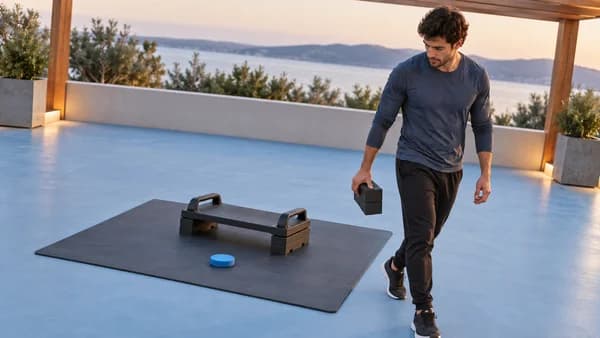
How to Build Muscle Without a Coach at Home
A practical beginner guide to building muscle without a coach, with a simple weekly home plan, progression rules, nutrition targets, and tracking habits.

Quick answer: you need a repeatable system, not a personal coach
Yes, a beginner can build muscle without a coach if the plan is simple, repeatable, and honest. The first need is not a secret exercise; it is a routine that trains the main movement patterns, asks the muscles to work a little harder over time, supports recovery with enough food and sleep, and records what happened. A coach can shorten the learning curve, but a written plan, good form videos, and a log can give you enough structure to start safely.
Use this article as a four-week starter system. You will train three days per week, keep most sets two reps away from failure, eat enough protein, and change only one variable at a time. If you later move from home to a gym, the same logic carries into a beginner gym workout plan because the principle is still controlled practice before complexity.
The minimum weekly plan
Start with three full-body sessions on non-consecutive days. Each session should include a squat or lunge pattern, a push, a pull, a hip-hinge movement, and a core hold. At home that can mean squats, push-ups, towel rows or band rows, glute bridges, Romanian deadlifts with a backpack, and planks. Do two or three working sets per exercise and stop when form is still clean.
A useful week looks like this: Monday full body, Wednesday full body with slightly easier variations, Friday full body again, then two easy walking days. The World Health Organization recommends muscle-strengthening work for major muscle groups on two or more days each week, so three controlled days is enough for a beginner to practice often without turning every day into a recovery problem.
Progress without guessing
Muscle grows when the body receives a repeated challenge it can recover from. Your decision rule is simple: when you complete all target reps with stable form for two sessions in a row, make the next session slightly harder. Add one or two reps, slow the lowering phase, add a pause, use a heavier backpack, or move to a harder bodyweight variation. Do not change five things at once.
This is the same idea explained in progressive overload for muscle growth. Progression does not need to be dramatic. A push-up that moves from 8 clean reps to 10 clean reps is progress. A squat with better depth and control is progress. If reps fall sharply, joints hurt, or sleep is poor, hold the level for another week instead of forcing more load.
Eat enough to let training work
Training sends the signal, but food supplies the material. Put a protein source in every meal: eggs, yogurt, chicken, fish, lean meat, lentils, beans, tofu, or whey if it suits you. A large meta-analysis on resistance training and protein found that benefits often level off around 1.6 grams of protein per kilogram of body weight per day, so beginners can use that as a practical ceiling rather than chasing extreme numbers.
Choose your phone
Put this advice into your next workout
Track the sets, loads, and progress behind what you just learned—without rebuilding the plan from memory.
iOS is available now. Android launch notifications are open.
If your body weight is not moving and you feel flat in workouts, add a small daily serving of carbohydrates such as rice, oats, potatoes, fruit, or bread. If you are also trying to lose fat, keep the calorie deficit modest and judge strength performance closely. Building muscle without a coach becomes much easier when meals are predictable and you are not guessing every night.
Technique, recovery, and safety
Your first technical rule is that the target muscle should work harder than your joints. In a push-up, the chest, shoulders, and triceps should drive the movement while the lower back stays quiet. In a squat, the feet stay planted, the knees track with the toes, and the depth is only as low as you can control. Film one set from the side when possible and fix the obvious issue before adding difficulty.
Sleep, rest days, and warm-ups are not optional extras. Keep at least one day between hard full-body sessions, start each workout with five minutes of easy movement, and avoid repeating hard sets when form has already collapsed. Many plateaus come from small basics, and the checklist in common muscle-building mistakes is useful when progress slows for two weeks.
Track the plan inside Rukn Fitness
A no-coach plan works only when the next session is based on evidence from the last one. Record the exercise variation, sets, reps, difficulty, and one form note. After two weeks, look for a pattern: which exercise improved, which one stalled, and whether recovery matched the plan. That review tells you whether to add reps, repeat the week, or reduce volume.
For a cleaner routine, log each workout decision in Rukn Fitness and compare your sessions instead of relying on memory. If you prefer a manual structure first, use a workout log template and copy the same fields into the app later. The goal is not perfect data; it is making the next workout easier to choose.
Mistakes to avoid
The biggest mistake is program hopping. Beginners often try a new routine every few days because soreness feels like proof, but muscle needs repeated exposure to the same movements. Keep the plan for four weeks before judging it. The second mistake is training every set to failure. Save true failure for occasional final sets, because constant failure makes technique worse and recovery harder.
The third mistake is treating home training as random exercise instead of resistance training. A hard set of split squats, push-ups, rows, or hip hinges still counts if you can progress it. The fourth mistake is ignoring pain. Muscle fatigue is expected; sharp joint pain is a signal to stop, simplify the variation, and rebuild control before pushing again.
Sources
Choose your phone
Keep training with the app
Track every set, follow smarter progressions, and bring your workout plan with you when you leave the article.
iOS is available now. Android launch notifications are open.