Muscle Pump vs Long-Term Gains: What the Feeling Can Tell You
A muscle pump describes this session, not future growth. Use three time horizons and a like-for-like workout log to judge progress.
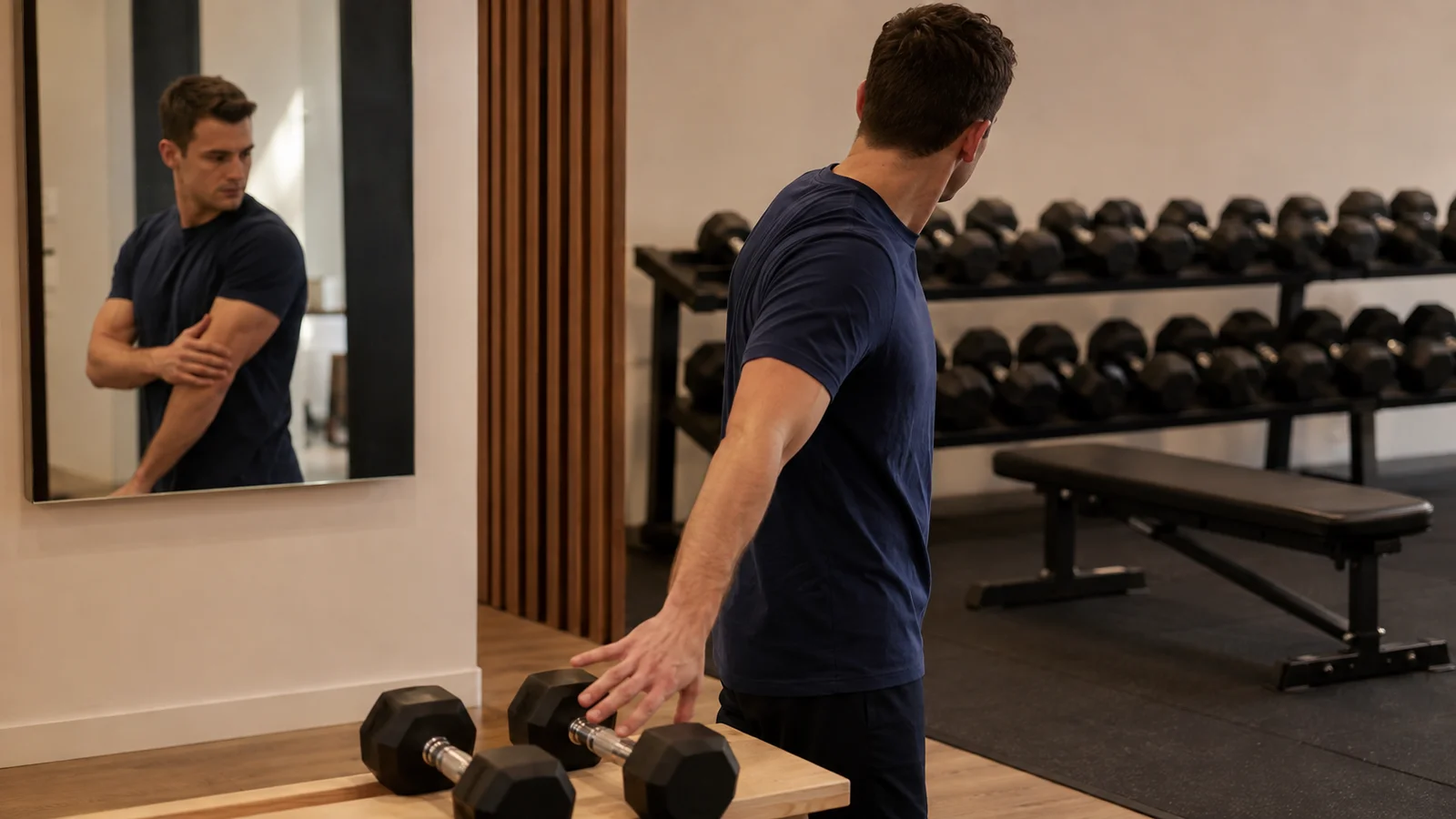
A muscle pump tells you that the trained area feels fuller right now. It does not prove that the workout was productive, that the target muscle will grow, or that a session without the same sensation failed.
The useful rule is to separate three time horizons: notice the pump during and just after the session, check performance the next time you repeat the exercise, and judge progress from several comparable weeks. A sensation can describe today. Your log is better suited to judging the trend.
Decision rule: use three time horizons
Use each horizon for a different question. Do not make them compete, and do not upgrade a pleasant sensation into proof.
- Right now: ask whether the intended muscle worked and whether the set felt locally demanding. A pump is one clue beside technique and range of motion, not a score.
- Next comparable session: with the same exercise, setup, range, and rest, check whether you repeated or improved load and repetitions at a similar effort.
- Across several weeks: judge whether comparable sets, useful work, technique, and recovery are moving in the intended direction. Repetition makes a trend credible.
Why the pump can change when growth has not
The post-set increase in size is acute swelling. Repetitions, set duration, rest, exercise choice, temperature, hydration, carbohydrate availability, and novelty can change it quickly; new muscle tissue does not appear between the final repetition and the locker room.
In 8 resistance-trained participants, volume-equated protocols at 50% and 85% of 1RM both produced acute swelling. The lower-load condition also used more repetitions, time under tension, and training density. The study does not decide which plan builds more muscle over months; it shows how session design changes the immediate signal.
A heavy set of five, a long-rest strength session, a cool room, or a familiar exercise may feel different from a high-repetition isolation set. If controlled work was completed and the progression plan remains on course, a mild pump is not a failed-workout warning.
What the research means: association is not a personal growth meter
One study followed 22 untrained participants for 6 weeks. Acute ultrasound muscle-thickness change after the first session was associated with the six-week change: average acute thickness rose 8.3%, average training-period thickness rose 2.9%, and the reported correlation was 0.443.
That finding does not mean a bigger subjective pump causes more growth or lets you rank two workouts by mirror appearance. Ultrasound thickness is not a lifter’s feeling, the sample was small and specific, and an association does not prove that deliberately maximizing swelling improves the outcome.
A 2025 critical review found that a causal contribution from cell swelling is not supported well enough to treat it as the mechanism or requirement for hypertrophy. The safe translation is simple: acute swelling and long-term growth are different outcomes, and the first cannot certify the second.
Comparison table: the biggest pump gives the weakest evidence
Imagine three cable-curl sessions with the same handle, stance, and intended range. The example is hypothetical and tests comparability, not an established muscle-gain result.
Choose your phone
Put this advice into your next workout
Track the sets, loads, and progress behind what you just learned—without rebuilding the plan from memory.
iOS is available now. Android launch notifications are open.
- Session A — 3 × 10 at 20 kg, 90 seconds of rest, about 2 repetitions in reserve, and a moderate pump: use it as the baseline.
- Session B — 3 × 15 at 15 kg, 45 seconds of rest, the final set near failure, and a very large pump: it is a different test, so do not call it progress over A.
- Session C — 3 × 11 at 20 kg, 90 seconds of rest, about 2 repetitions in reserve, and a mild pump: three extra total repetitions under comparable conditions are clearer progression evidence.
Session B may feel strongest because it packs more repetitions into shorter rests. Yet it changes load, repetition range, rest, and effort, making it the weakest comparison. Session C feels less dramatic but answers the progression question more cleanly.
Adding three repetitions does not establish hypertrophy. The narrow lesson is that comparable performance gives a more stable decision input than the size of an immediate pump.
What to record instead of a pump score
You can keep sensation in your notes without making it the main metric. For a useful comparison, record:
- the exact exercise and setup, including a machine or handle change
- load and completed repetitions for each work set
- a consistent range of motion and technique standard
- rest time when it materially affects performance
- proximity to failure, such as an honest repetitions-in-reserve estimate
- obvious disruptions such as pain, illness, severe sleep loss, or a different exercise order
If your records are vague, the workout-log mistakes guide explains which details make later decisions easier.
If you change load only to chase a sensation, the rep-range guide can help you choose a range that fits the exercise while keeping the set honest.
Then ask one clean question: did performance improve under conditions close enough to compare? One day can be noisy; a repeated direction across several exposures deserves more confidence.
Mistake to avoid: forcing a pump after the work is done
A pump can be a useful local cue while learning an exercise or adjusting a setup. If a grip or seat change shifts work into an unintended area, the sensation can prompt a technique check. It may also be enjoyable, and enjoyment can support adherence.
Keep a cue in its proper role. Stop if the “pump” is sharp pain, sudden swelling, numbness, weakness, or another unusual symptom. This article covers ordinary exercise sensations and does not diagnose an injury or medical condition.
Do not add unplanned sets only to recreate the feeling after the intended work is complete. More swelling is not automatically more useful training, and extra work still carries a recovery cost.
Use workout history for the question it can answer
completed-set exercise history lets you revisit completed-set loads and repetitions in exercise history. It does not measure pump, blood flow, hydration, or muscle size. Use the record for the narrower job it can do well: compare the same exercise across sessions.
After training, keep the pump in the “today” column. At the next exposure, compare the same movement under similar conditions. After several weeks, review the direction rather than the most memorable day.
The decision loop is: notice the immediate cue, compare the next like-for-like session, and judge the multi-week trend. The mirror may show temporary fullness; it cannot grade the program. Let comparable history earn your confidence.
Sources
Choose your phone
Keep training with the app
Track every set, follow smarter progressions, and bring your workout plan with you when you leave the article.
iOS is available now. Android launch notifications are open.