Superset Workout: Save Time Without Hurting Strength
Use a simple superset decision rule to pair exercises, keep priority lifts honest, and shorten gym sessions without corrupting progress.
Quick answer: pair the support work, protect the scored lift
A superset workout saves time when it pairs exercises that do not steal the signal you are trying to measure. Keep straight sets for the lift you score most closely, such as a heavy squat, bench press, deadlift, or overhead press. Use supersets around support work: a row with a press, a curl with a pressdown, calves with lateral raises, or core work after a machine accessory.
The quick answer is simple: if the second exercise makes the next set weaker in a way you cannot explain, the pairing is too expensive. If the next set stays technically clean and the reps are close to normal, the pairing probably belongs. When rest is the real problem, use the deeper guide to setting a useful workout rest timer instead of turning every exercise into a superset.
Comparison table: green, yellow, and red pairings
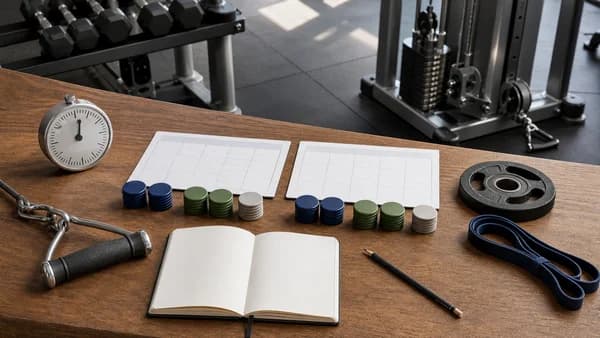
Think of supersets as a comparison table, not a personality test. Green pairings use stable, non-competing exercises and usually save time with little confusion: cable row plus dumbbell press, hamstring curl plus calf raise, or face pull plus curl. Yellow pairings can work but need a log check: pull-up plus push-up, split squat plus plank, or leg press plus lateral raise. Red pairings usually punish the same weak link twice: heavy squat plus walking lunge, deadlift plus bent-over row, or bench press plus hard dips when pressing strength is the day's score.
This green, yellow, red rule also protects shared-equipment reality. A superset that needs two busy stations can waste more time than it saves, and it can make other lifters wait. Pick pairings you can control in one small area, then write the pairing into the workout before you start. If two stations are far apart, walking, waiting, and protecting space can erase the time saving, so pair a cable with a dumbbell or choose two support moves that live in the same small zone. If the plan is already being shortened, the minimum effective training session framework helps you decide what to keep before you decide what to pair.
Choose your phone
Put this advice into your next workout
Track the sets, loads, and progress behind what you just learned—without rebuilding the plan from memory.
iOS is available now. Android launch notifications are open.
What the research means in the gym
The evidence does not say supersets are magic. The 2026 ACSM position stand draws from 137 systematic reviews and more than 30,000 participants, which is a reminder to protect measurable progression before chasing a denser style. A 2025 systematic review and meta-analysis on supersets supports their time-efficient potential, but the practical result still depends on exercise order, rest, and fatigue. In a randomized trial of whole-body supersets, lifters trained for 10 weeks, 2 days per week; the time savings were useful, but some traditional-set outcomes were stronger on pulling exercises. The decision is not "supersets or no supersets." The decision is "which pairings keep next week's numbers trustworthy?"
Example week: a 45-minute upper-body session
Example week: on Monday, keep the first bench press block as straight sets because that is the strength signal. Then pair a chest-supported row with a dumbbell incline press, rest long enough to breathe normally, and record whether either movement loses more than one or two clean reps. Pair curls with pressdowns near the end because they are low-skill, easy to share, and less likely to distort the main lift. In Rukn Fitness, the useful move is not just finishing faster; it is keeping paired-set notes beside the next repeat session so you can see whether the shortcut actually worked.
On Thursday, repeat the idea for lower body without forcing every movement into a pair. Keep squats or Romanian deadlifts straight. Pair hamstring curls with calf raises, or a machine leg extension with a calm core drill. If the second exercise changes bracing, grip, or depth on the next important set, loosen the rest or split the pairing. A good superset workout should make a 45-minute session cleaner, not turn the priority lift into a conditioning test.
Mistakes to avoid when supersets get messy
Mistake to avoid: pairing two exercises just because they are near each other. Convenience is useful only when performance remains readable. Another mistake is hiding same-muscle fatigue under different exercise names; a dumbbell press after hard dips is still pressing fatigue. The last mistake is judging the superset from one exciting workout. Audit the next repeat session: keep the pairing if load, reps, and technique stay stable; loosen rest if the second exercise is useful but costly; split it if the priority lift keeps dropping. If you are unsure, test the pairing for one week and write one verdict in the log: keep, more rest, or split.
Sources
Choose your phone
Keep training with the app
Track every set, follow smarter progressions, and bring your workout plan with you when you leave the article.
iOS is available now. Android launch notifications are open.