Creatine vs Protein Powder: Which Should You Buy First?
Creatine and protein powder solve different problems. Use this four-outcome test to choose protein, creatine, both, or neither without wasting money.
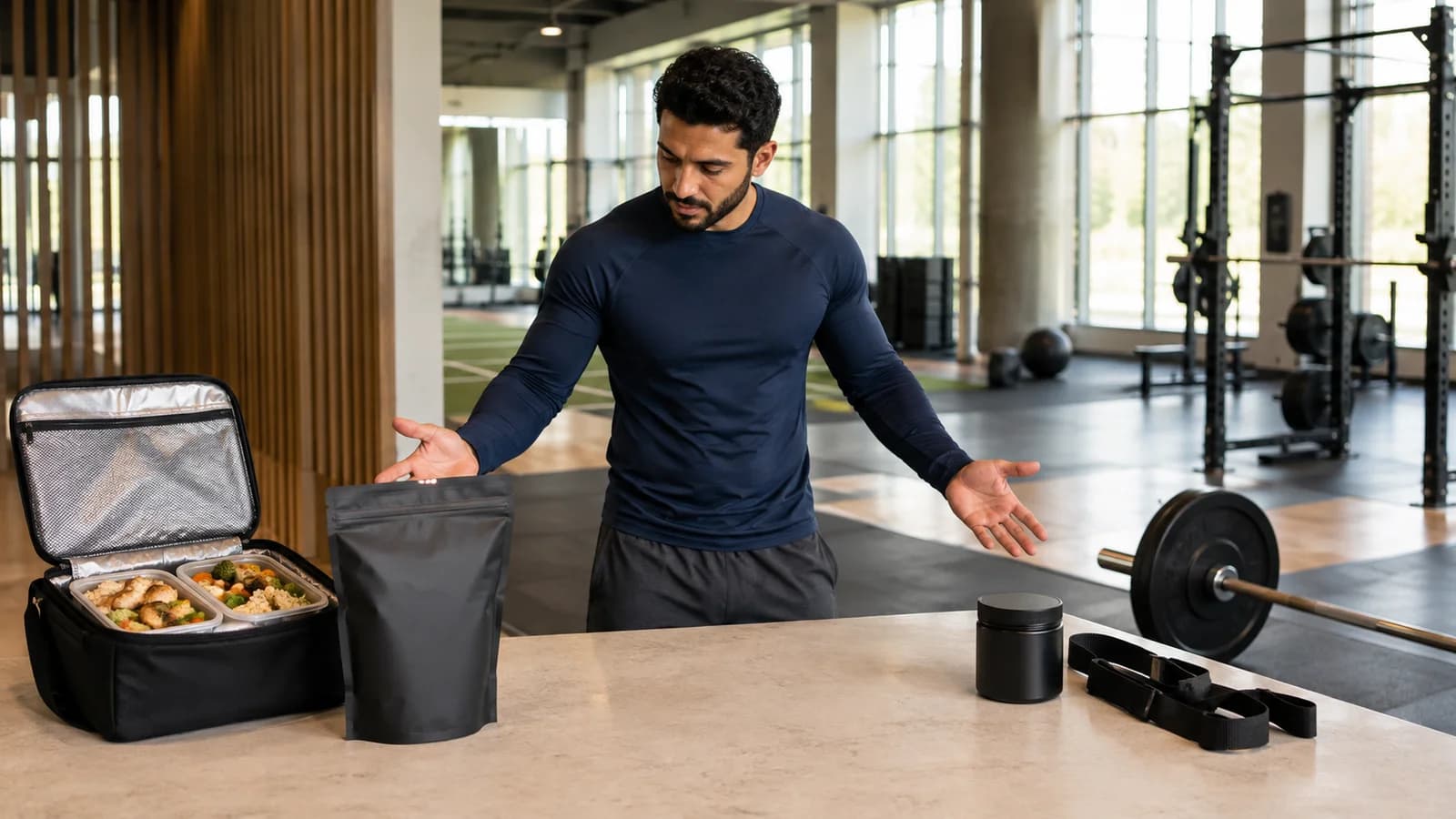
Creatine and protein powder sit on the same supplement shelf, but they do not do the same job. Protein powder is concentrated food: it helps when normal meals leave a repeatable protein gap. Creatine is a performance supplement: it can support brief, repeated high-intensity work when training is already consistent. The useful question is not which product builds more muscle. It is which missing job is limiting you now.
Quick answer in one minute: match the product to the job
- Choose protein powder first if several normal days show that meals regularly leave you short of a reasonable protein intake.
- Choose creatine first if protein intake is already covered, resistance training is repeatable, and you want support for hard sets or repeated bursts of effort.
- Choose both if you can identify both gaps independently and the cost, digestion, and routine remain easy.
- Choose neither if meals, total energy, or training consistency are still the main bottleneck.
This is not a winner-takes-all contest. A scoop of protein does not increase muscle creatine stores, and creatine does not supply the essential amino acids used to build and repair tissue. Start with the missing job, then judge whether a product is the simplest way to do it.
Protein powder solves an intake problem
The NIH Office of Dietary Supplements summarizes sports-nutrition guidance at roughly 1.2-2.0 grams of protein per kilogram per day for athletes, depending on training and context. For a 75 kg lifter, that broad range is about 90-150 g per day. That calculation is not a personal prescription. It is a practical audit range: if ordinary meals land near 95 g most days, one convenient protein serving may close a real gap; if meals already supply about 130 g, another shake may not be the highest-value purchase.
A meta-analysis covering 49 studies and 1,863 participants found modest average gains from protein supplementation alongside resistance training, with the fat-free-mass benefit leveling around 1.6 g/kg/day of total protein. The point is not that 1.6 is a magic ceiling for everyone. The decision lesson is that extra protein is most useful when it fills missing intake; once intake is already adequate, more powder is not automatically more muscle.
Powder wins on convenience, portability, and a predictable serving. Food wins on variety, fullness, micronutrients, and the ability to build an actual meal. If yogurt, eggs, fish, poultry, beans, lentils, or other preferred foods can close the gap comfortably, protein powder is optional rather than superior.
Creatine solves a training-energy problem
Creatine works through a different pathway. The Australian Institute of Sport explains that stored creatine and phosphocreatine help supply energy for about 8-10 seconds of maximal exercise. That is why creatine is relevant to repeated hard sets, sprints, and other brief intense efforts. It does not replace protein, calories, sleep, or a progressive training plan.
The average benefit is real enough to consider but small enough to measure honestly. A recent 12-study meta-analysis found 1.14 kg more lean body mass with creatine plus resistance training than training alone. Lean body mass includes water, and the estimate is an average across studies, not a promise of 1.14 kg of new muscle for you. A separate 23-study strength meta-analysis supports a distinct strength role, but its subgroup results also remind us that responses vary. The decision lesson is simple: creatine may make consistent training slightly more productive; it cannot rescue an inconsistent program.
If creatine is the chosen tool, plain creatine monohydrate has the strongest evidence base. The NIH fact sheet describes 3-5 g per day as a typical adult maintenance range. Loading is optional, timing is secondary to a repeatable routine, and our guide to taking creatine before or after a workout handles that next decision without pretending there is a narrow anabolic window.
Choose your phone
Put this advice into your next workout
Track the sets, loads, and progress behind what you just learned—without rebuilding the plan from memory.
iOS is available now. Android launch notifications are open.
Run the four-outcome bottleneck test
First, estimate protein from three to seven ordinary days, not from your best meal-prep day. Second, inspect training: have the same main exercises, working sets, and effort been repeated for several weeks? Third, identify one limiting job.
Use this scenario map to make the bottleneck visible. Consider a 75 kg lifter averaging about 95 g of protein. Training is steady, but meals become sparse on workdays. Protein powder is the clearer first purchase because it closes a visible intake gap. Creatine could still help later, but it does not solve the missing-food problem.
Now consider another 75 kg lifter averaging about 130 g from normal food while completing a repeatable resistance program. More protein powder mainly adds convenience. Creatine is the more distinct experiment because the protein job is already covered and the training signal is stable enough to observe.
Finally, consider a new lifter who skips breakfast, trains once one week and four times the next, and changes exercises constantly. Buying both products creates two new expenses but no clean signal. Neither is the first answer; three repeatable meals and a stable weekly program are.
Compare the tradeoffs before you spend
Protein powder is a larger daily food serving. It adds protein and usually some energy, may displace a more complete meal, and can be inconvenient if dairy, sweeteners, texture, or plant blends upset digestion. Its value rises when portability is the constraint. Its value falls when food already covers the target or the shake crowds out fruit, vegetables, carbohydrates, and fats needed for the rest of the diet.
Creatine uses a much smaller daily amount and does not replace a meal, but it asks for consistent use and patient interpretation. Early scale weight can rise because water is stored with lean tissue. Some people report gastrointestinal discomfort. If a sport uses drug testing, product-quality and contamination controls matter. If you have kidney disease, are pregnant or breastfeeding, are under medical care, take medicines that affect the decision, or are buying for a young athlete, ask a qualified clinician or sports dietitian before using a supplement.
The decision rule for your budget is concrete: buy the product whose job you can name and whose result you can observe. Do not pay for protein when there is no protein gap. Do not pay for creatine when training is too irregular to expose a small performance benefit. Use both only when two independent needs survive that test.
Measure one change so the answer stays visible
Do not start both products on the same day if you want to learn which one helped. For protein powder, track several normal days of total protein, keep the training plan stable, and review whether the serving actually closes the gap without replacing useful food. For creatine, keep the same key exercises and record load, repetitions, effort, and body-weight context across comparable weeks.
A dated note inside your Rukn Fitness training log can mark when the one change began, while the guide to workout-log mistakes that hide progress helps keep setup, effort, and recovery context comparable. The log cannot prove a supplement caused every improvement, but it prevents a much bigger error: changing exercises, volume, sleep, diet, and two supplements at once, then crediting the tub with the loudest label.
Comparison mistakes to avoid
Do not ask which powder builds muscle faster without checking food and training. Do not count an early creatine-related scale increase as pure muscle. Do not use a shake to excuse a diet that lacks enough total energy or variety. Do not treat 1.6 g/kg as a mandatory target for every person. And do not keep a product merely because it is popular: keep it only when its job remains necessary, tolerable, affordable, and measurable.
The final rule is short. Protein powder closes a protein-intake gap. Creatine supports repeated high-intensity training. Both can be useful together because their jobs differ. Neither deserves priority over a repeatable diet and resistance program.
Sources
Choose your phone
Keep training with the app
Track every set, follow smarter progressions, and bring your workout plan with you when you leave the article.
iOS is available now. Android launch notifications are open.