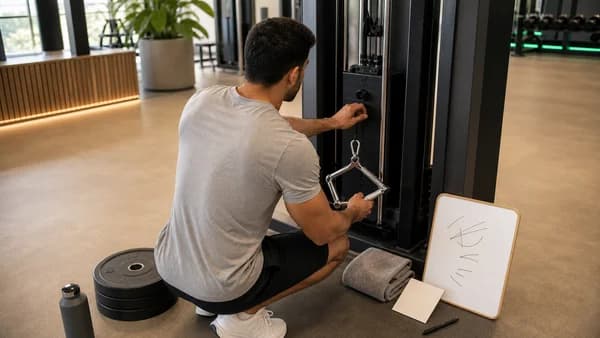
First Week Back at the Gym: Restart Without Overdoing It
Plan your first week back at the gym with lighter loads, simple sessions, smart warm-ups, and a log-based decision rule for week two.

The first week back at the gym should not feel like a debt collection. If you have been away for travel, work, illness recovery, Ramadan rhythm changes, or a simple motivation dip, your old numbers are useful reference points, not commands. The goal is to leave the gym with enough information to train again, not enough soreness to avoid the next session.
Quick Answer: Make Week One a Calibration Week
Quick answer: plan two clear strength sessions, keep most working sets around 1-3 reps in reserve, shorten the exercise list, and write down one honest note after each lift. If the old load feels heavier than expected, that is not failure; it is data. Restarting works better when you treat the week as a test of rhythm, technique, and recovery instead of a test of identity.
First-Week Checklist: Lower The Cost Of Restarting
- Pick familiar exercises before new variations.
- Use fewer total sets than your normal peak week.
- Stop a set when bar speed, range, or form changes sharply.
- Keep one easy cardio or mobility day optional, not mandatory.
- Review soreness after the workout before adding more work.
This checklist is intentionally plain. A dramatic comeback session may feel satisfying for one hour, but a readable first week helps you see what the break actually changed. If your schedule is messy, two productive sessions beat six rushed make-up workouts.
Use A Step-Back Rule Before You Load The Bar
Start from the last load you could control before the break, then step back enough that the first working set feels almost too clean. If you are unsure, use the same reasoning you would use when choosing a useful starting load: the first number should create repeatable reps, not prove courage. After a week away, a small reduction may be enough. After several weeks, the first session may need a larger reset and fewer accessories.
Do not chase a big jump because the first set feels good. ACSM progression guidance uses small earned increases, such as 2-10%, after the current workload is clearly repeatable. On a comeback week, that means you earn the next increase after the log shows clean reps, stable RIR, and tolerable soreness, not because you remember what you lifted last month.
Choose your phone
Put this advice into your next workout
Track the sets, loads, and progress behind what you just learned—without rebuilding the plan from memory.
iOS is available now. Android launch notifications are open.
Decision Rule After Each Workout
Decision rule: if reps, technique, and soreness are all green, add a small amount next time; if performance is fine but soreness or joint irritation lingers, repeat the session; if reps collapse early, reduce the load or remove one set. This is where reviewing your set history in Rukn Fitness helps because the comeback decision sits beside real loads, reps, RIR, and notes instead of memory.
Warm-ups matter more after time away because the first few sets tell you how the day is responding. Use ramp-up warm-up sets that reveal readiness before the first heavy-ish set, then log the working sets with enough detail that week two is obvious. A short note like “same load, two RIR, hamstrings tight next day” is more useful than a heroic session you cannot interpret.
What The Research Means For Your Comeback
Public-health guidance says adults should include muscle-strengthening activity on at least 2 days per week. For a return week, that number is permission to be focused: two well-managed sessions can restart the habit without pretending you must rebuild a full split immediately. The RIR research gives the effort rule practical language; leaving 1-3 reps in reserve keeps the first week hard enough to learn from and controlled enough to repeat.
Soreness is also delayed. ACSM describes delayed onset muscle soreness as something that can feel strongest 24-72 hours after unaccustomed exercise, which is exactly why the first week should not be judged only by how good the first workout felt. Use the 24-72 hour window as a check before adding volume. If soreness is mild and performance is stable, progress. If soreness is loud, repeat or reduce.
Example Week: A Clean Return
Example week: Monday is a short full-body lift with squat pattern, press, row, hinge, and one core exercise. Each lift gets two working sets, the last set stops with about two reps in reserve, and the log captures load, reps, and one recovery note. Wednesday is a walk or easy cardio if it makes you feel better, not because you owe punishment. Thursday repeats the same lift pattern with the same or slightly adjusted loads.
At the end of the week, compare the two sessions with a simple workout log template. If the second session looked cleaner, add the smallest load jump or one set to one priority movement next week. If the second session looked worse, the plan still worked: it showed that your body needed another calibration week before old volume returns.
Sources
Choose your phone
Keep training with the app
Track every set, follow smarter progressions, and bring your workout plan with you when you leave the article.
iOS is available now. Android launch notifications are open.