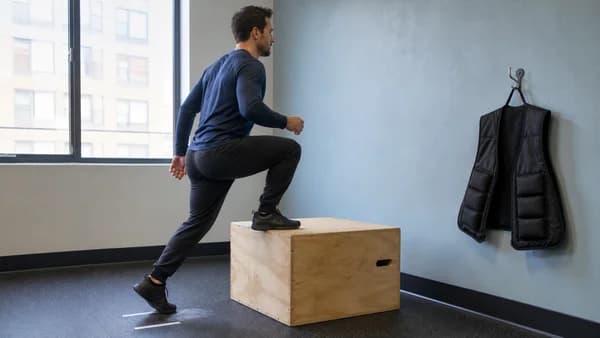
Bodyweight Progression Checklist: Choose Reps, Range, Leverage, or Load
Compare two push-up or squat entries, identify what actually changed, and choose one measurable progression for your next session.
Bodyweight exercises stop feeling simple the moment the easy answer—add more weight—is unavailable. Use this rule instead: keep the exercise recognizable, check what actually limited the last clean set, and change only one thing next time. Add repetitions while they remain controlled; standardize range of motion before you claim progress; change leverage when clean repetitions have become too easy; add a small external load when a harder variation would be too large or too unstable a jump.
Choose the next lever with this checklist
Before you progress a push-up or squat, compare the last two entries for the same named variation. The floor, hand or foot support, range, tempo, set count, rest, and effort target should be close enough that the records answer the same question. Then use the first matching row:
- Add repetitions when the current variation still feels challenging, every repetition uses the agreed range, and the later sets have room to improve.
- Improve or extend range when the repetition count rose only because the movement became shorter, or when you can now control a useful range that was not available before.
- Change leverage or variation when all sets are clean near the top of your chosen range and another five or ten repetitions would mainly make the set longer rather than meaningfully harder.
- Add a small external load when you have stable technique but the next bodyweight variation demands too much balance, skill, or joint tolerance to be a sensible step.
- Repeat the same prescription when setup, range, rest, or effort changed. An unfair comparison does not earn a progression.
This is a decision table, not a universal exercise ladder. Your goal is to choose the smallest change that keeps the next session measurable. If you want the loaded-exercise version of the repetitions-first idea, the double progression method explains how to build repetitions before increasing weight.
Repetitions come first only while they stay honest
More clean repetitions are the easiest bodyweight progression to see. If three sets of incline push-ups move from 8, 8, 7 to 10, 9, 8 with the same bench height, full range, rest, and effort target, keep the variation and build the later sets. You have not yet run out of useful room.
But repetitions are not automatically better. Twelve push-ups that stop several centimetres higher than last week are a change in range, not proof that the same exercise improved. Twenty-five rushed squats may train a different quality from ten controlled repetitions. Set a practical range for the movement and goal, then stop using repetitions as the only lever once the sets become long, loose, or dominated by breath rather than the target muscles.
The American College of Sports Medicine’s 2026 resistance-training summary says bodyweight and home-based training can improve strength and function, and recommends training all major muscle groups at least 2 days per week while building gradually. So what? You do not need to test a new variation every day. Two repeatable weekly exposures can give you enough evidence to progress calmly while leaving recovery between them.
Worked push-up example: the bigger number loses
Consider this hypothetical log:
- Session A: floor push-up, 3 sets of 10, chest reaches the same marker, 90 seconds of rest, about two clean repetitions left.
- Session B: floor push-up, 12, 10, 8, but the chest stops above the marker after repetition seven.
Session B shows effort, not a clean twelve-repetition progression. The next action is not feet-elevated push-ups. Repeat the floor variation and restore the chosen range across the whole set. The full-range and partial-repetition guide is useful if you need to define which version belongs in the log.
Choose your phone
Put this advice into your next workout
Track the sets, loads, and progress behind what you just learned—without rebuilding the plan from memory.
iOS is available now. Android launch notifications are open.
This range check is supported, with limits, by a systematic review and meta-analysis of 16 studies. Full-range training generally favored strength and lower-body hypertrophy over partial range in that analysis, although not every outcome differed. The practical decision is modest: make range a named variable. Do not let it shrink invisibly while the repetition number rises.
If a later session reaches 12, 12, 11 with the same range and control, add one repetition to the last set before changing leverage. If all sets reach the chosen ceiling twice and remain clean, a modest leverage change—such as moving from a high incline to a slightly lower, stable surface—can start a new baseline. Record the new variation as new evidence rather than pretending it is the old push-up with better numbers.
Worked squat example: choose skill or load, not both
Now imagine a beginner records bodyweight squats for 3 sets of 15. The same stance, depth target, rest, and controlled tempo are present in two sessions, and the second session finishes with clear reserve. More repetitions are possible, but the reader wants a strength-focused next step.
There are two reasonable doors. A split squat increases the share of work handled by one leg, but it also raises balance and coordination demands. A lightly loaded squat keeps the familiar two-leg pattern but adds external resistance. Choose the split squat if balance and single-leg control are part of the goal and a stable support is available. Choose the small load if balance would hide leg effort and the object can be held securely. Do not introduce the split squat and the load in the same session; you would not know which change caused the new difficulty.
A small randomized study helps show why bodyweight work deserves to be logged like resistance training, while also warning against sweeping promises. It followed 18 young men for 8 weeks, training twice per week, and found similar chest and triceps adaptations between adjusted push-ups and a low-load bench press performed at a matched relative load. The sample was narrow and the study does not create a universal push-up ladder. Its useful message is that a controlled variation can provide a real training stimulus; the exact variation is therefore part of the prescription, not a disposable label.
Record the variation so the history stays comparable
For every bodyweight exercise, keep four details together: the exact variation, completed sets and repetitions, the range or support cue, and the one next action. “Push-up” is too vague if one week used a kitchen counter and the next used the floor. “Squat” is too vague if one session stopped at a chair and the next used a deeper unsupported range.
Rukn Fitness already lets you record completed sets and repetitions for an exercise and review its history. Use the workout log on iOS to preserve the numbers you actually performed, then keep your variation standard consistent enough that the history remains meaningful. The app does not see your range, tempo, leverage, or rep quality and does not choose the next progression for you; that judgment stays with you.
End each exercise with one short instruction: “add one rep to set three,” “repeat full range,” “lower the incline one step,” or “add the smallest secure load.” A useful bodyweight progression checklist does not make every session more complicated. It makes the next change obvious—and keeps the evidence clean enough to know whether that change worked.
Sources
Choose your phone
Keep training with the app
Track every set, follow smarter progressions, and bring your workout plan with you when you leave the article.
iOS is available now. Android launch notifications are open.