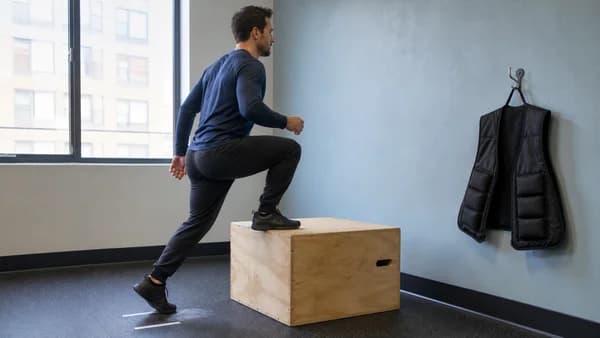
The Barbell Warm-Up Ramp: Reach Working Weight Without Fatigue
Build warm-up sets before lifting by raising load, lowering reps, and stopping when the first working weight feels predictable—not tiring.

Your first working set should test the training target—not finish the job your warm-up skipped. Jumping from a cold start to the planned load can make the movement feel unfamiliar. Filling the ramp with hard repetitions creates the opposite problem: the first recorded set begins after fatigue has already arrived. Warm up sets before lifting work best as a short bridge between those errors. The bridge is complete when the movement feels rehearsed, the next load jump feels predictable, and you still feel eager to perform the work set.
Quick Answer: Match the Ramp to the Gap
Use the fewest sets that remove surprise from the first working load. A practical default is one to four warm-up sets for the first demanding lift of the session, then fewer for later exercises that reuse the same joints and movement pattern. This is a decision range, not a universal scientific dose. Choose from the gap in load, skill, and readiness:
- Use one warm-up set when the working load is modest, the movement is familiar, and an earlier exercise already prepared the same pattern.
- Use two sets when you need a light rehearsal followed by one near-working check.
- Use three or four sets when the first lift is heavy or technical, the room or your body feels cold, the empty implement sits far below the work load, or the setup is unfamiliar.
Stop adding steps when the final jump is small enough to feel unsurprising and the last rehearsal rep is crisp. If a warm-up rep slows because of effort, the ramp is no longer only preparation.
Build the Ramp From the Working Load Backward
Start with the load you intend to train, then plan the last warm-up set just below it. Add an earlier bridge only if the jump into that final rehearsal would still feel abrupt. The first step can use comfortable repetitions to confirm stance, grip, brace, range of motion, and equipment position. As load rises, repetitions should fall. That keeps the movement specific while limiting fatigue. The point is not to collect volume; it is to make the work load feel like the next logical step.
Here is one illustration, not a universal evidence-derived prescription. If today's squat work sets begin at **100 kg**, you might use the empty bar for **8 controlled reps**, **50 kg for 5**, **75 kg for 3**, and **90 kg for 1**, then begin the work at 100 kg. The load rises while the repetitions fall, and every step rehearses the same lift. If the 90 kg single is crisp and the final 10 kg jump feels ordinary, stop the ramp. If it feels awkward, fix the setup or add a small bridge; do not turn the rehearsal into a grinding test. A lighter, familiar target may need only the first and last checks, while a larger gap may justify all four.
**What the research means:** The newest international consensus used **23 experts from 12 countries** and describes warm-ups as structured, purposeful, and dependent on the athlete and task. Its three-layer model separates general activity, exercise-specific rehearsal, and optional conditioning work. For a normal lifting session, the exercise-specific layer does most of the useful work; the other layers are tools, not obligations. A broader review of **32 studies** found improvement in **79%** of the performance criteria examined after adequate active warm-ups. A 2020 experiment in **40 resistance-trained men** also found that specific warm-up protocols affected bench press and squat differently, reinforcing that the useful ramp belongs to the task rather than to one copied formula. So the practical conclusion is to prepare deliberately—not to repeat one long ritual before every exercise.
Choose your phone
Put this advice into your next workout
Track the sets, loads, and progress behind what you just learned—without rebuilding the plan from memory.
iOS is available now. Android launch notifications are open.
Make Every Warm-Up Set Earn Its Place
**Decision rule:** A set earns its place when it answers a question: Does the position feel right? Is the equipment adjusted correctly? Does the movement path stay controlled? Does the next load jump now feel manageable? Remove a set if it merely repeats an answer you already have. Keep every rehearsal comfortably away from strain; the guide to deciding where hard working sets should end belongs after the ramp, not inside it.
More complicated is not automatically better. In a 2024 crossover study of **14 resistance-trained men**, adding either a heavy primer or a fast light primer did not significantly improve total repetitions or total volume across the later multi-set squat session compared with a usual specific warm-up. A heavy rehearsal may suit a tested strength routine, but it is not a free upgrade. If it makes you grind, demands a long recovery, or leaves the next set less clear, it has failed the basic job of preparation.
Keep Later Exercises Shorter
The first demanding lift receives the fullest ramp because it must prepare both the body and the exact skill. Later exercises inherit some of that preparation. After pressing, a second press variation may need only a light setup check and a near-working rehearsal. After rows or pull-downs, another stable pulling exercise may need one brief set—or none when the opening load is already easy and the setup is familiar.
**Mistake to avoid:** Do not skip the check when the later exercise introduces a new movement pattern, a large load gap, a sensitive joint position, or equipment you have not used recently. The rule is not “first exercise warms everything.” The rule is “repeat only the preparation that the new task still needs.” That distinction saves time without pretending that every machine, bar path, and range of motion is interchangeable.
Let the Last Rehearsal Change the Session
The last warm-up set is a checkpoint, not a promise that the written workout must continue unchanged. Proceed when the movement is controlled, the load moves as expected, and the next jump is ordinary. Recheck the setup when the bar path or range feels unfamiliar. Reduce the planned load when the rehearsal is clearly slower or harder than comparable days. Stop and seek appropriate professional guidance when pain, dizziness, or another concerning symptom appears; a warm-up can reveal a problem, but it does not prove that training through it is safe.
If the signal is less dramatic—poor sleep, unusual stiffness, or a load that simply feels wrong—use the workout readiness checklist for a keep, reduce, or rest decision. That prevents one strange rehearsal from becoming either an automatic cancellation or an ego-driven work set. The value of the ramp is the option to change course before the set that matters.
Log the Work, Note the Exception
Warm-up sets normally should not inflate the working-set volume you use to judge progression. Record the load, repetitions, and effort of the actual work sets. Note the warm-up only when it changed the plan: a different stance solved the movement, an extra bridge was required, the first target load was reduced, or the exercise was replaced. Inside Rukn Fitness, keep the progression signal tied to comparable working sets and attach a short exception note when today's ramp revealed something the next session should remember.
That leaves a clean decision for the next workout. Repeat the same ramp when it was efficient and the first work set was ready. Shorten it when a step added nothing. Add a bridge when the final jump remained abrupt. A good warm-up is not the one that feels busiest; it is the one that makes the first working rep feel like a continuation rather than a surprise.
Sources
The evidence behind this decision guide includes the 2026 international expert consensus on warm-up protocols, the systematic review and meta-analysis of warm-up and performance, the specific warm-up study in bench press and squat, and the 2024 comparison of lower- and higher-load squat warm-up protocols. Together they support purposeful, exercise-specific preparation while showing why the exact ramp should remain brief and context-dependent.
Choose your phone
Keep training with the app
Track every set, follow smarter progressions, and bring your workout plan with you when you leave the article.
iOS is available now. Android launch notifications are open.