Choose a Starting Weight for a New Exercise in One Session
Use one controlled eight-rep trial, a practical RIR corridor, and a confirmation set to choose a repeatable starting weight without max testing.
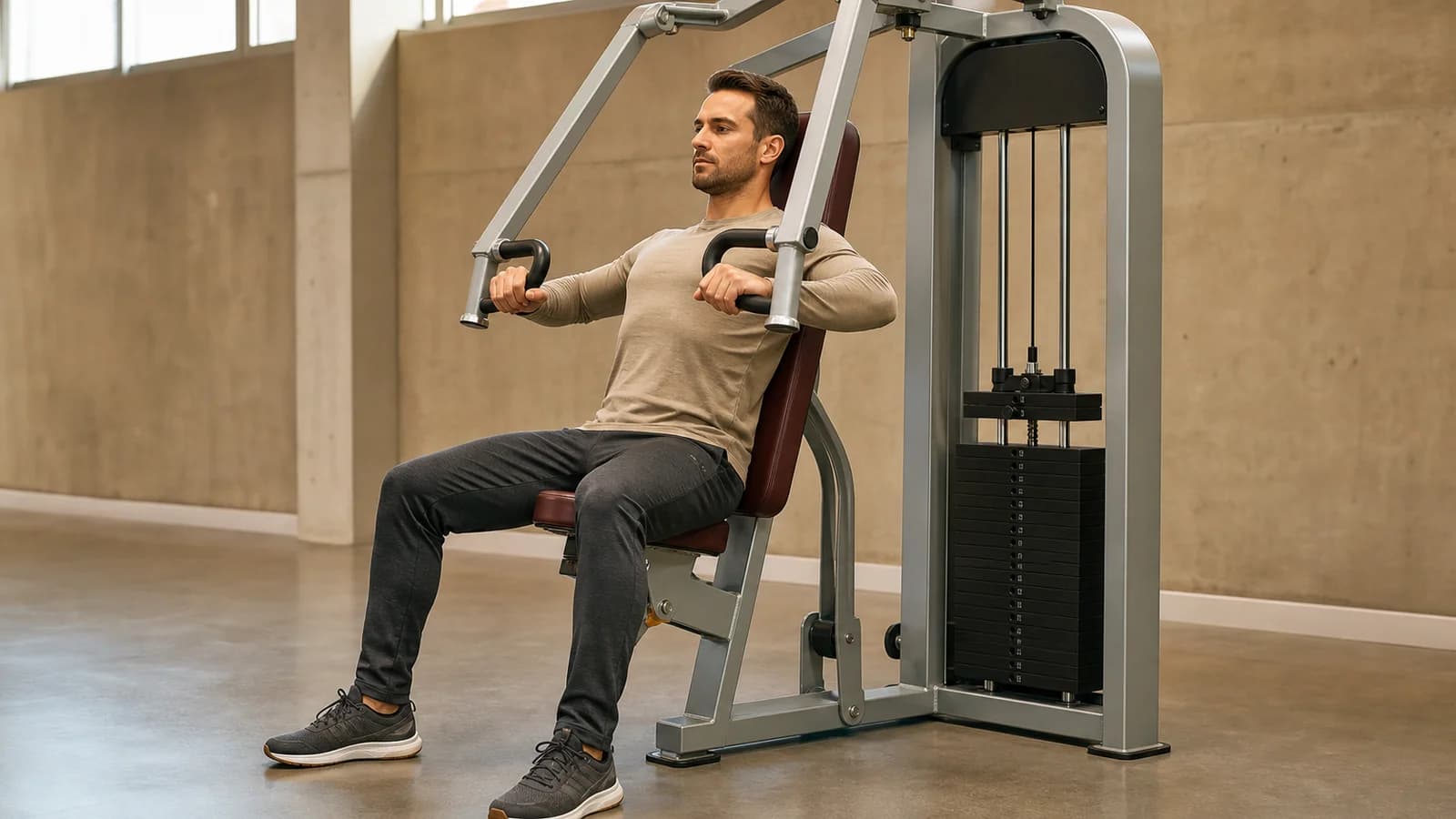
At a half-kneeling landmine press for the first time, your dumbbell press number does not transfer: bar angle, lever arm, stance, and plates create a different task. Today's goal is to decide whether this exact version offers a trustworthy starting entry—and to leave without one if it does not.
The First-Session Load Ladder
First-session checklist: On an exercise you have never logged, make five decisions in order:
- Fix the seat or stance, grip, range, and tempo; plan eight repetitions.
- Choose a weight you expect to control. Stop at eight even if more are available.
- Ask how many equally clean reps remained. This framework aims for two to four RIR.
- More than four? Add one increment. Fewer than two or changed technique? Remove one. After either change, run another same-setup eight-rep trial and reassess; advance only when the weight lands inside two to four RIR.
- Then rest and run a separate eight-rep confirmation with that same weight and setup. Save only if effort and form repeat; otherwise leave without a starting weight.
This ladder is an applied framework, not a validated universal protocol. The 2026 ACSM position stand synthesized 137 systematic reviews and more than 30,000 participants, finding broad benefits from varied progressive resistance-training prescriptions. It does not select your first plate; it shows why day one need not chase a perfect percentage before establishing a reproducible movement.
Fix the Exercise Before You Judge the Weight
A different seat height, foot position, grip, range, or tempo can make the same number behave like a different exercise. Rehearse with minimal resistance first. Choose one pain-free range you can control, secure the equipment, and keep those conditions unchanged. Eight reps with more momentum or a shorter range are not comparable with the first eight.
Unfamiliar coordination can also make a manageable weight feel difficult. Give yourself a few slow practice reps before judging effort. If you still cannot keep the intended stance, path, and control, the useful decision is to keep learning the exercise—not to hunt for a number that hides the problem.
Use the Trial Set to Find the Effort Corridor
The 2024 RIR scoping review examined 31 studies with 855 mostly male participants. RIR scales appeared contextually feasible and useful for selecting and adjusting resistance-training intensity, while estimates tended to be more accurate nearer task failure. What the research means: Treat RIR as an estimate, not a hidden rep counter. The two-to-four-RIR band leaves room for uncertainty while keeping an unfamiliar movement away from a forced final repetition.
Eight reps are used here to make one planned trial easy to follow, not because research declares eight universally ideal. If your program or exercise calls for another target, first choose a suitable rep range that keeps the set honest, then keep the same movement definition, effort check, and second look. Do not perform extra repetitions merely to verify your prediction; that would turn the first encounter into failure testing.
Let the Confirmation Set Veto the Guess
In the linked 141-participant prediction study, participants predicted before each single set how many repetitions they could complete, then performed the set to momentary failure. The standard errors of measurement were about 2.64 to 3.38 repetitions, and accuracy tended to improve with experience. The study did not test the post-set method in this article. Using a second set with the same setup is a conservative editorial inference for a new exercise: it reduces the chance that one unfamiliar effort estimate becomes your permanent entry.
Choose your phone
Put this advice into your next workout
Track the sets, loads, and progress behind what you just learned—without rebuilding the plan from memory.
iOS is available now. Android launch notifications are open.
Scenario map: Suppose you try the half-kneeling landmine press with one 5 kg plate. Eight clean reps leave at least five more, so you add the available 2.5 kg increment. After normal rest, eight reps at 7.5 kg leave roughly three clean reps. Rest again and repeat the exact stance and bar position. If that set also ends near three RIR with stable technique, record 7.5 kg for that setup. If it falls to one RIR or your torso twists, lower the load or record no starting point yet.
Adjust the Smallest Thing That Solves the Miss
Hold the weight when both sets preserve the intended movement and effort. Raise one increment when the technique is steady and more than four clean reps remain. Lower it when fewer than two remain, speed collapses, range shortens, or another body part takes over. If a machine's next jump is too large, keep the lighter option; forcing the stack upward adds no useful information on the first day.
The 2023 systematic review and Bayesian network meta-analysis included 178 strength studies with 5,097 participants and 119 hypertrophy studies with 3,364 participants. All evaluated resistance-training prescriptions improved strength and hypertrophy versus no exercise; higher loads ranked best for strength, while all prescriptions promoted hypertrophy. Unlike the ACSM overview's broad case for progressive training, this synthesis gives the next-step perspective: today's starting entry does not lock you into one load zone. Your goal and later performance decide how it develops.
Save a Baseline You Can Repeat
Record the exact exercise version, equipment or attachment, seat or stance, load, eight reps, estimated RIR, and one technique note from the second set. Machine labels and landmine setups are not interchangeable, so the number belongs to the equipment and movement you used. If your log normally stores weight without context, these workout-log mistakes and fixes explain why a technically different set can create false progress.
Next session, rebuild those conditions and compare the planned set instead of guessing again. If keeping the details together would help, you can record the load, reps, and exercise notes in Rukn Fitness while the set is fresh. The app does not choose the weight; it preserves what you need to make the next choice with less uncertainty.
When a Starting Weight Is Not a Green Light
Sharp or increasing pain, numbness, joint instability, uncontrolled range, or uncertainty about how equipment locks are not requests for a different plate. Stop the trial and get qualified help with the movement or symptom. A lighter weight cannot make an unsafe setup trustworthy.
A day-one number earns a green light only when you can repeat the intended movement without pain, rescue, or improvised range. On a complex lift, that may mean practicing unloaded and returning another day. Leaving without a saved weight is a successful safety decision when control is still missing.
Sources
- ACSM position stand on resistance-training prescription (2026) — overview of 137 systematic reviews covering more than 30,000 participants.
- Scoping review of RIR scales for selecting exercise intensity (2024) — 31 studies and 855 participants.
- Study of pre-set repetition-to-failure prediction accuracy (2017) — 141 participants who predicted repetitions before single sets to momentary failure.
- Network meta-analysis of resistance-training prescriptions (2023) — 178 strength studies and 119 hypertrophy studies.
Choose your phone
Keep training with the app
Track every set, follow smarter progressions, and bring your workout plan with you when you leave the article.
iOS is available now. Android launch notifications are open.