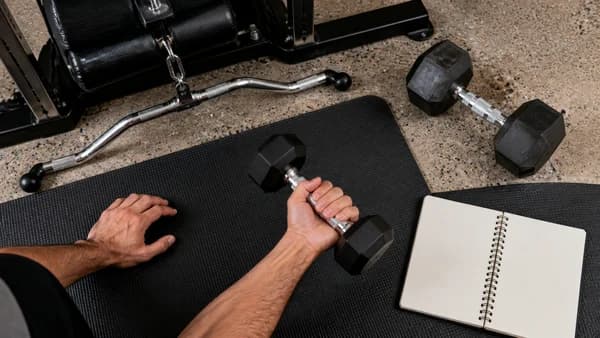
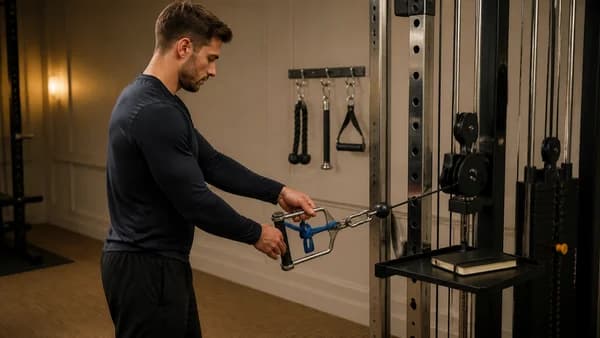
Workout Tempo for Muscle Growth: Slow Enough to Control, Not Count Every Rep
Use tempo as a repeatable control rule, not a magic slow count. Pick one honest cadence, keep range consistent, and log tempo changes separately.

Quick Answer: Tempo Is Control, Not Magic
Workout tempo for muscle growth is useful when it makes the rep repeatable. It is not useful when it turns every set into a slow-counting ritual. Use one honest rhythm for each exercise: lower with control, keep the same range of motion, lift with intent, and stop the set when form or target-muscle tension would clearly change. If your normal reps are already controlled, you do not need to stretch every repetition into a drama.
The practical rule is simple. Choose a cadence you can repeat next week, then compare load, reps, range, and effort under that same rule. If you change tempo, treat it as a new variation, because a slower descent can make the same weight feel like a different exercise. This is similar to choosing a useful rep range for muscle growth: the number matters only if the set stays honest.
What the Research Says About Rep Speed
Research translation: the strongest direct tempo signal is not "slower is always better." Schoenfeld, Ogborn, and Krieger found 8 eligible studies in their repetition-duration review, and hypertrophy outcomes were broadly similar when reps lasted about 0.5 to 8 seconds. They also noted that very slow reps above 10 seconds may be inferior, though the evidence was limited. That makes tempo a control variable, not the main growth switch.
The 2026 ACSM resistance-training position stand also points away from magical timing. It reviews a large body of resistance-training evidence and reports that variables such as time under tension did not consistently change outcomes across reviews. Load still matters for strength, and Schoenfeld's low-load versus high-load meta-analysis defined low-load training as 60 percent of 1RM or less, high-load training as above 60 percent of 1RM, and required protocols of at least 6 weeks. So do not slow reps so much that useful effort, loading, or progression disappears.
Pick Tempo by Exercise Job
Decision rule: choose tempo by the exercise's job. For big compound lifts, start with controlled but normal reps: a steady lower, no bounce, a brief change of direction, and a strong lift. For isolation lifts, a slightly slower lowering phase can help you feel the target muscle and avoid swinging. For movements where you tend to cut depth, a short pause can prove that the bottom position is real.
Choose your phone
Put this advice into your next workout
Track the sets, loads, and progress behind what you just learned—without rebuilding the plan from memory.
iOS is available now. Android launch notifications are open.
Tempo should protect the exercise's job. If slowing a squat makes you lose your brace, the tempo is too demanding. If rushing a lateral raise turns it into a shrug, slow it down. If a partial rep is intentional, log it that way; if it happens by accident, use the full range of motion versus partial reps rule before chasing more weight.
When to Slow Down or Pause
Checklist: slow down when the rep has a problem you can actually see: bouncing off the bottom, collapsing posture, drifting joints, or losing the target muscle. Add a pause when you need proof of control at one position, not because every hypertrophy set needs a frozen count. Keep pauses short enough that the exercise remains trainable.
Do not slow down just to make a light set feel hard. There is a difference between productive control and making fatigue artificially messy. If the slower version reduces load, reps, or recovery, it may still be useful, but you need to compare it as its own tempo variation rather than pretending the numbers are equal.
Log Tempo Changes Separately
In Rukn Fitness, log tempo changes in the exercise note or as a separate variation. A set of 10 controlled reps and a set of 10 slow-paused reps are not the same signal, even if the load matches. Your history should tell you whether the new tempo improved control, range, and target-muscle feel without hiding a drop in useful work.
Keep effort in the picture too. A tempo that keeps you 2 reps from failure is not comparable to a faster set that ends near failure. Use the training to failure for muscle growth decision as a guardrail: chase hard, repeatable sets first, then use slower tempo only when it makes the set clearer.
Sources
- Schoenfeld et al. on repetition duration found similar hypertrophy across roughly 0.5 to 8 seconds per rep in 8 studies and limited concern for very slow reps above 10 seconds.
- The 2026 ACSM resistance-training position stand supports progressive training while showing that time-under-tension variables did not consistently dominate outcomes.
- Schoenfeld et al. on low- versus high-load training helps explain why tempo should not destroy useful loading and hard-set effort.
- Refalo et al. on proximity to failure reinforces that effort context matters when comparing tempo variants.
Choose your phone
Keep training with the app
Track every set, follow smarter progressions, and bring your workout plan with you when you leave the article.
iOS is available now. Android launch notifications are open.