Dumbbell Weight Jump Too Big? Microload Small Exercises
When the next dumbbell is too heavy for lateral raises or curls, use rep ranges, microloading, or a smarter tool swap before forcing form.
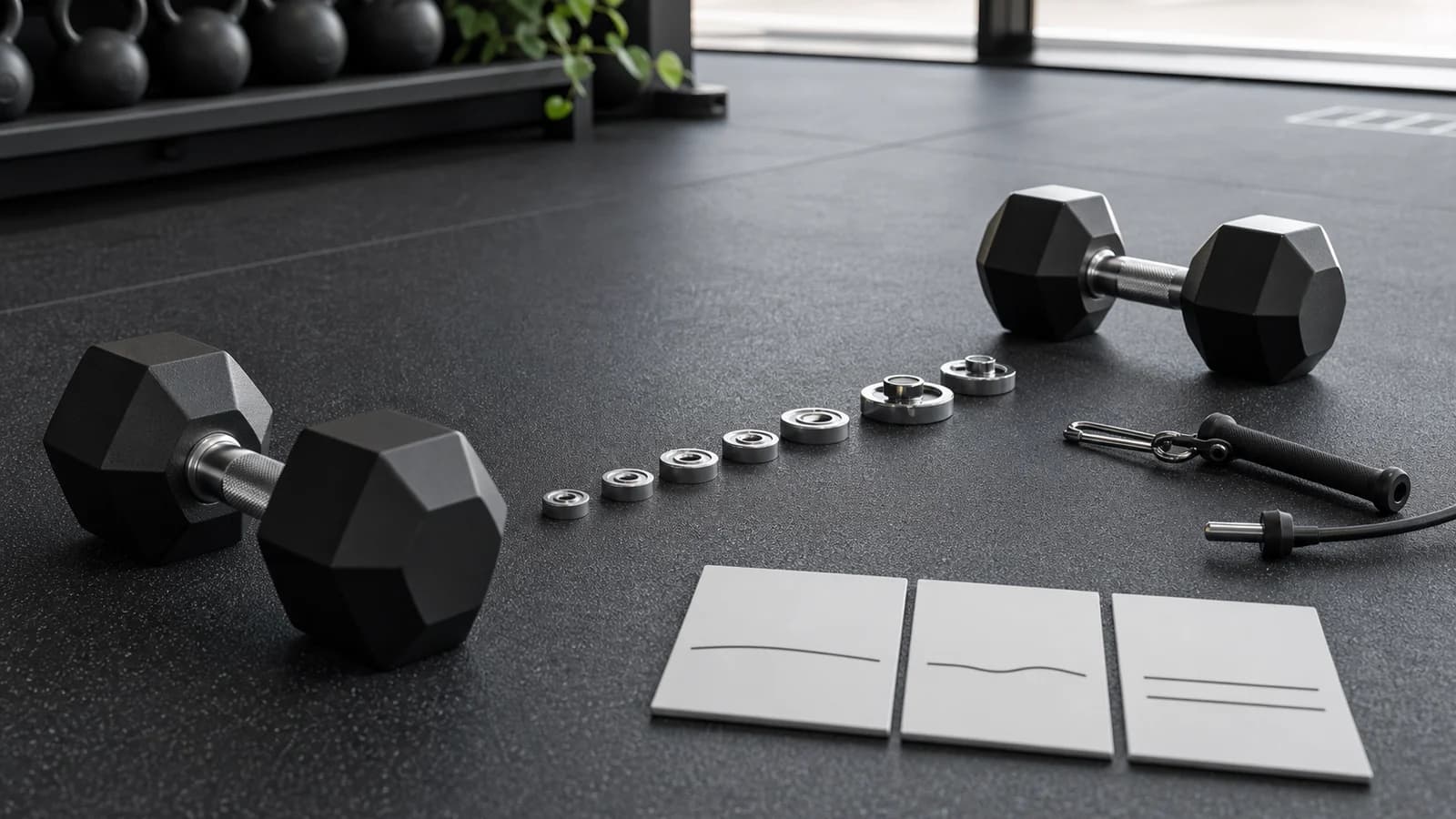
Small exercises stall for a boring reason: the dumbbell rack moves in jumps bigger than your shoulder, biceps, or rear-delt technique can honestly absorb. A 2.5 kg jump might be fine on a leg press, but it can be a massive change on lateral raises. The useful question is not whether you are weak; it is which progression signal should move next.
Quick answer: use the smallest honest step
Quick answer: do not force the heavier dumbbell if it changes the exercise. First add reps within a planned range. If the top of the range is clean for two repeat exposures, use microloading if available. If neither option exists, choose a cable or machine version with smaller jumps and keep the same movement job. The general clean weight increase checklist still applies, but this article solves the small-increment problem that checklist cannot fix by itself.
- If the next pair changes range of motion, stay with the current load and add 1-2 reps.
- If you can attach small plates safely, microload by the smallest clear step.
- If equipment jumps are still too wide, switch to a cable, machine, or band-assisted version for a short block.
Decision rule: reps, microload, or change tools
Decision rule: choose reps when the current dumbbell is still challenging, choose microloading when the movement is clean but the rack jump is too large, and choose a tool swap when the exercise is limited by available equipment instead of strength. This is why a lateral raise can progress from 10 kg for 10 reps to 10 kg for 14 reps before 12.5 kg is even useful.
Put a percent on the jump before you judge yourself. Going from 10 kg to 12.5 kg is a 25% increase per hand; going from 4 kg to 6 kg is 50%. ACSM's progression model describes load increases in the 2-10% range once the target reps are exceeded, so many dumbbell racks simply skip over the honest next step for small exercises. When that happens, reps and microplates are not a workaround; they are the more precise progression.
If a cable station gives you smaller plates or a smoother setup, treat it as a planned variation, not a failure. The machine-or-free-weight decision rule is useful here: pick the tool that trains the target muscle and lets next week be compared fairly.
What the research means
What the research means in practice: load is only one way to progress. Research comparing lower-load and higher-load resistance training generally supports hypertrophy across a wide loading spectrum when sets are hard enough, while heavier loads remain more specific for maximal strength. For a small isolation exercise, that means a clean 12-rep set that becomes a clean 15-rep set can be useful progress even if the dumbbell has not changed.
Choose your phone
Put this advice into your next workout
Track the sets, loads, and progress behind what you just learned—without rebuilding the plan from memory.
iOS is available now. Android launch notifications are open.
A small-increment study tested 0.22 kg (0.5 lb) and 0.44 kg (1 lb) additions after an initial 8 weeks of traditional progression. It does not prove that every lifter needs microplates forever, but it does show why very small jumps can be a practical tool when normal rack increments are too blunt. The decision is simple: use microloading when it preserves the movement and the record; skip it when it turns setup into the main workout.
Do not solve the problem by taking every set to a messy max. Reviews on training to failure suggest failure is not a magic requirement for strength or hypertrophy, and it can make small-exercise technique harder to read. Use the RPE and RIR effort scale so the last few reps are hard enough to matter without becoming a shoulder shrug, hip swing, or half curl.
Scenario map: the lateral raise rack gap
Scenario map: your lateral raise goal is 3 sets of 10-15. Week one is 10 kg for 12, 11, and 10 reps with two reps in reserve. Week two becomes 13, 12, and 11. Week three reaches 15, 14, and 13 with the same range of motion. Now you can test the next step: add a 0.5 kg magnetic plate per hand, move to a cable stack with smaller jumps, or try 12.5 kg only for the first set and drop back if the first reps climb instead of raise.
For curls, the same map can be stricter because cheating appears quickly. If the elbow drifts forward and the torso leans back, the heavier pair is not a biceps progression yet. Stay with the old load, slow the lowering, or add one clean rep per set until the target range is honest.
Log the repeat so next week is obvious
The key is to make the next repeat easy to interpret. In a workout history that keeps reps, load, and effort notes together, write the reason for the choice: 10 kg stayed clean; added reps, or 12.5 kg changed form; use cable next week. That note matters because small-exercise progress is often visible as cleaner reps before it is visible as a bigger dumbbell.
Review two repeat exposures before you celebrate or panic. If the same load gains reps or feels easier at the same reps, the plan is working. If reps fall, effort spikes, and form changes across two sessions, the problem may be recovery, exercise order, or too much failure work rather than the dumbbell jump itself.
Mistakes to avoid
Mistake to avoid: turning microloading into a new obsession. Fractional plates help when the gap is too large, but they are not superior to every other progression method. If attaching them is unsafe, slow, or distracting, use rep ranges, a machine, or a cable instead.
Another mistake is changing five variables at once. Do not raise load, shorten rest, change tempo, and swap exercises in the same week. Pick one signal, keep the target muscle and range stable, and let the log tell you whether the small step was real.
Sources
Choose your phone
Keep training with the app
Track every set, follow smarter progressions, and bring your workout plan with you when you leave the article.
iOS is available now. Android launch notifications are open.